It is an excellent method to achieve a fast and effective improvement of flexibility. The NFP emerged as a therapeutic method of muscle rehabilitation in victims of blows and accidents, then was adopted by sports and physical activity, to increase the flexibility levels of athletes and athletes. Its’
phases are:
Isometric tensión: In the first phase we take the articulation to its maximum
extension, with the help of a partner or a machine we create an isometric
tension (we push against a resistance in the opposite direction, but without
moving) for about 10 seconds.
Muscle relaxion: Relax the muscle during 5 seconds.
Gentle streching: The one who is doing the exercise must force to the opposite side of the
partner is doing during 20 seconds.
QUADRICEPS
- Stand in front of the wall looking
and raise the leg back bending the knee.
- Call a friend tell him to push up
your leg durig 10 seconds.
- Relax during 5 seconds.
- Push your leg up another time and
make strenght to the oposite side of your partner during 20 seconds.
HAMSTRINGS

- Lie down with straight legs.
- Call a frend, tell him to push
straight one of your legs during 10 seconds. Relax during 5 seconds.
- Push your leg up another time strenght
to the oposite side of your partner during 20 seconds.
GENERAL SYNDROME
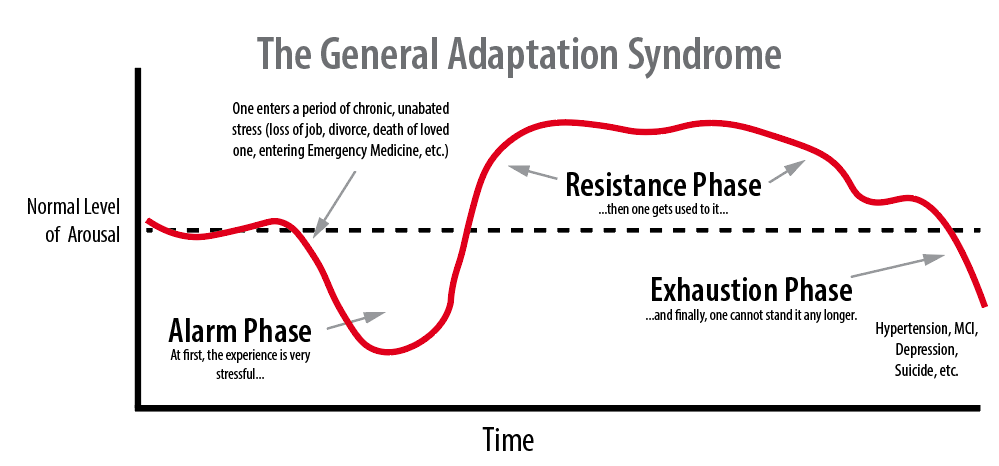
GAS is the three-stage process that describes the physiological changes the body goes through when under stress. Hans Selye, a medical doctor and researcher, came up with the theory of GAS. During an experiment with lab rats at McGill University in Montreal, he observed a series of physiological changes in the rats after they were exposed to stressful events.With additional research, Selye concluded that these changes were not an isolated case, but rather the typical response to stress. Selyeidentified these stages as alarm, resistance, and exhaustion. Understanding these different responses and how they relate toeach other may help you cope with stress. It’s important because
stress can cause mental fatigue, irritability, and insoa common occurrence. While you can’t remove every single stressor from your life, it’s possible to manage stress and maintain your health. This ismnia. It's phases are:
Alarm reaction stage: The alarm reaction stage refers to the initial symptoms the body experiences when under stress. You may be familiar with the “fight-or-flight” response, which is a physiological response to stress. This natural reaction prepares you to either flee or protect yourself in dangerous situations. Your heart rate increases, your adrenal gland releases cortisol (a stress hormone), and you receive a boost of adrenaline, which increases energy. This fight-or-flight response occurs in the alarm reaction stage.
Resistange stage: After the initial shock of a stressful event and having a fight-or-flight response, the body begins to repair itself. It releases a lower amount of cortisol, and your heart rate and blood pressure begin to normalize. Although your body enters this recovery phase, it remains on high alert for a while. If you overcome stress and the situation is no longer an issue, your body continues to repair itself until your hormone levels, heart rate, and blood pressure reach a pre-stress state.
Some stressful situations continue for extended periods of time. If you don’t resolve the stress and your body remains on high alert, it eventually adapts and learns how to live with a higher stress level. In this stage, the body goes through changes that you’re unaware of in an attempt to cope with stress.
Your body continues to secrete the stress hormone and your blood pressure remains elevated. You may think you’re managing stress well, but your body’s physical response tells a different story. If the resistance stage continues for too long of a period without pauses to offset the effects of stress, this can lead to the exhaustion stage.
Signs of the resistance stage include:
- irritability
- frustration
- poor concentration
Exhaustion stage: This stage is the result of prolonged or chronic stress. Struggling with stress for long periods can drain your physical, emotional, and mental resources to the point where your body no longer has strength to fight stress. You may give up or feel your situation is hopeless. Signs of exhaustion include:
- fatigue
- burnout
- depression
- anxiety
- decreased stress tolerance
The physical effects of this stage also weaken your immune system and put you at risk for stress-related illnesses.

THERSHOLD LAW
This theory strarts from the existence of a threshold or a minimum estimate necessary for some modification, improvement or adaptation to occur in the organism. This is a very personal issue.
There is also a maximum tolerance or point from which only fatigate and overtraining occurs. According to this law, adaptation takes place as a consequence of physical efforts proposed in a consistent and adequate manner so that the organism assimilates them progressively.
In the trainings we can find:
- STIMULUS BELOW THE THRESHOLD OR OF EXCESSIVELY LOW INTENSITY:
They don´t have training effects or require any recovery. EXAMPLE: If I intend to do weights by lifting a balloon.
- EFFECTS ABOVE THE THRESHOLD:
*Medium intensity: They have a function of maintenance of the functional level in horts periods of time.
Optimal: The functional level, that is, training. This is typical of athletes.
*Excessively strong: They cause functional damage and can lead to overtraining and injures.
The optimum threshold to work the force is 30-40% of our maximum possibilities. In resistance: at least we must work between 50-60% of the maximum cardiovascular possibilities. In speed: the stimuli have to be maximum, with what is reached 90-100%.
TRAINING LOAD
This new metric allows you to monitor and evaluate your weekly training loads based on total physiological impact. Restoration and adaptation are your body’s natural responses to physical activity. EPOC values provide a window into the amount of work that will be performed in response. Longer more intense activities require more restorative work than lighter activities.
The Firstbeat analytics engine transforms heartbeat data recorded during any workout into EPOC values. EPOC values accumulated during each training session over a rolling 7-day are tallied and used to provide a new perspective into the restorative and adaptive work your body is doing in response to training.

OLIVER (1985)
· Principles related to the stimulation of physical condition.
· Principles related to the systems to which said stimulus is
directed.
· Principles
related to the response to said stimulus.
ZINTL(1991)
· Those who initiate the adaptation.
· Those that guarantee adaptation.
· Those
who exercise a specific control of adaptation.